
You found the home. You made the offer. It got accepted. You are officially under contract on a home in Monmouth County, and you are riding that incredible high that every buyer knows.
And then someone mentions the home inspection, and suddenly you have approximately four hundred questions.
What exactly does a home inspection cover? How long does it take? What happens if they find something? And what does the inspector actually look for when they are walking through the home you are about to spend a significant portion of your life savings on?
After more than 20 years helping buyers purchase homes in Monmouth County, I can tell you that home inspections are one of the most misunderstood parts of the entire process. Buyers either expect too much from them or do not understand them well enough to use the results effectively.
So let us clear all of that up right now. Here is exactly what home inspections in Monmouth County cover, what they do not cover, and everything you need to know to make the most of one of the most important steps in your home purchase.
What Is a Home Inspection and Why Does It Matter When Buying in Monmouth County?

A home inspection is a visual examination of a property conducted by a licensed home inspector before the sale is finalized. The inspector evaluates the condition of the home’s major systems and components and provides you with a written report detailing their findings.
Home inspections in Monmouth County are not required by law, but they are strongly recommended — and in most cases your real estate contract will include a home inspection contingency that gives you the right to negotiate repairs or walk away from the deal based on the findings.
Think of a home inspection as your last clear look at exactly what you are buying before you sign your name on the dotted line. It is not a guarantee that nothing will ever go wrong with the home. It is a professional assessment of the condition of the property on the day of the inspection.
For buyers purchasing a home in Monmouth County — where home prices are significant, and the housing stock ranges from brand new construction to century-old Victorians — a thorough home inspection is not optional. It is essential.
What Do Home Inspections in Monmouth County Actually Cover?

A standard home inspection in Monmouth County covers the visible and accessible components of the home. Here is a detailed breakdown of what your inspector will evaluate.
The roof. Your inspector will evaluate the condition of the roofing material, the flashing around chimneys and vents, the gutters and downspouts, and any visible signs of damage, aging, or improper installation. They will note the approximate age of the roof and flag any areas of concern. In Monmouth County, where we get everything from nor’easters to summer thunderstorms, the condition of the roof is one of the most important things to understand before you buy.
The foundation and structure. The inspector will look for signs of settlement, cracking, or movement in the foundation. They will check the structural integrity of the framing, the floor joists, and any visible structural components in the basement or crawl space. Monmouth County has a lot of older homes and foundation issues are not uncommon — knowing about them before closing is critical.
The exterior. This includes the siding, trim, windows, doors, walkways, driveways, grading, and drainage around the home. Proper grading — meaning the land slopes away from the foundation — is especially important in Monmouth County given our rainfall and proximity to water.
The electrical system. Your inspector will evaluate the main electrical panel, look for any outdated or unsafe wiring, check outlets and switches throughout the home, and flag any visible code concerns. Older homes in Monmouth County sometimes have knob-and-tube wiring or Federal Pacific panels, both of which are significant findings worth understanding.
The plumbing system. The inspector will check the water supply lines, drain lines, water heater, and visible plumbing fixtures throughout the home. They will look for signs of leaks, corrosion, improper installation, and drainage issues.
The heating and cooling systems. Your inspector will evaluate the furnace, the air conditioning system, and any visible ductwork. They will note the age and condition of the equipment and flag any operational issues. In Monmouth County, where summers are hot and winters are cold, knowing the condition of your HVAC system before you buy is not something to skip.
The insulation and ventilation. Proper insulation and ventilation affect your energy efficiency, your comfort, and the long-term health of the home. Your inspector will check the attic, the basement, and any accessible crawl spaces.
The interior. This includes walls, ceilings, floors, windows, doors, and stairs throughout the home. The inspector will look for signs of water damage, structural movement, and deferred maintenance.
The fireplace and chimney. If the home has a fireplace, the inspector will evaluate the visible components of the firebox and chimney from the interior and exterior.
What Do Home Inspections in Monmouth County NOT Cover?

This is the part that surprises most buyers — and it is just as important as knowing what is included.
A standard home inspection in Monmouth County does not cover everything. There are significant things that fall outside the scope of a general inspection, and understanding those limitations is critical to protecting yourself as a buyer.
Radon. Radon is a naturally occurring radioactive gas that can accumulate in homes, particularly in basements and lower levels. It is the second leading cause of lung cancer in the United States, and it is invisible and odorless. Radon testing is not included in a standard home inspection in Monmouth County — it is a separate test that typically costs between $150 and $300. Given that parts of New Jersey have elevated radon levels, this is a test I strongly recommend to every buyer.
Mold. A general home inspector will note visible signs of what appears to be mold, but they are not licensed mold inspectors, and they will not test for mold or provide a definitive mold assessment. If your inspector flags a concern or if you notice any musty smells or water staining during your tours, a separate mold inspection is worth the investment.
Sewer and septic systems. A standard home inspection does not include a sewer scope or septic inspection. In Monmouth County, many homes — particularly in more rural areas — are on septic systems, and even homes connected to public sewer can have deteriorating or root-infiltrated sewer lines. A sewer scope inspection involves running a camera through the sewer line to check its condition and typically costs between $150 and $300. It is money very well spent.
Underground oil tanks. Many older homes in Monmouth County were heated by oil at some point, and some of those homes have underground oil storage tanks that were simply abandoned in place when the heating system was converted. An abandoned underground oil tank that has leaked is an environmental liability and an extremely expensive remediation problem. A standard home inspection will not identify a buried oil tank. If you are buying an older home in Monmouth County, ask about the history of the heating system and consider hiring a company to scan the property for underground tanks.
Swimming pools and hot tubs. Most general home inspectors do not evaluate pools or hot tubs as part of a standard inspection. If the home has a pool, ask about adding a pool inspection or hire a pool specialist separately.
Chimneys. While your inspector will note visible concerns from the interior and exterior, a full chimney inspection requires a certified chimney sweep with a camera. If the home has a fireplace and chimney, a Level 2 chimney inspection is worth considering, especially on older Monmouth County homes.
Pest and termite inspection. Wood-destroying insect inspections — commonly called WDI inspections — are separate from a general home inspection. In New Jersey, lenders often require a termite inspection before closing. Make sure this is scheduled separately and do not assume it is included with your general inspection.
Chinese drywall, lead paint, and asbestos. These are specialty inspections that fall outside the scope of a standard home inspection. Lead paint is a concern in homes built before 1978, and asbestos can be found in older insulation, floor tiles, and other materials in homes built before 1980. If you are buying an older home in Monmouth County, ask your inspector about any visible concerns in these areas.
How Long Does a Home Inspection Take in Monmouth County?
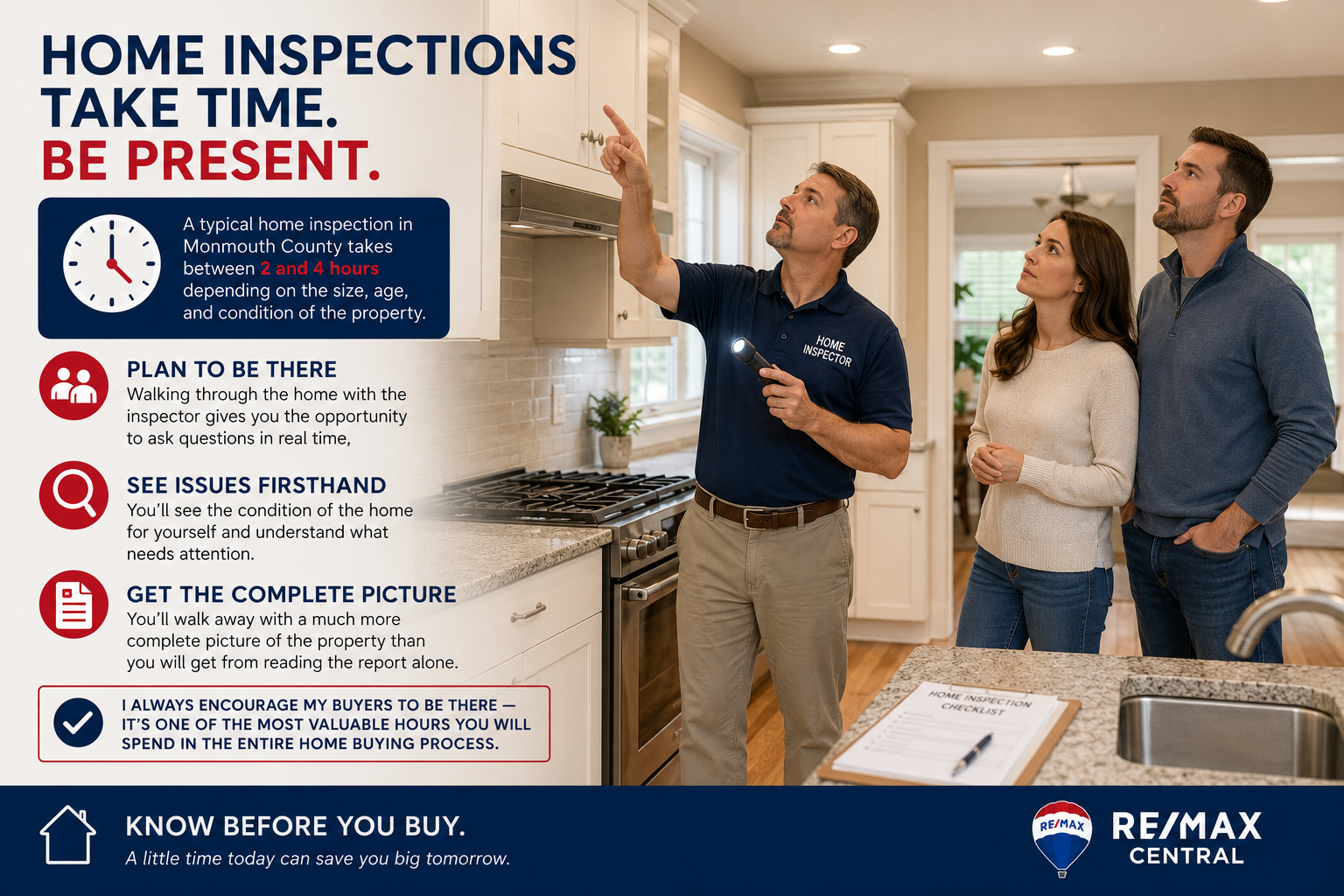
A typical home inspection in Monmouth County takes between two and four hours depending on the size, age, and condition of the property. Larger or older homes may take longer.
Plan to be present for the inspection if at all possible. Walking through the home with the inspector gives you the opportunity to ask questions in real time, see issues firsthand, and get a much more complete picture of the property than you will get from reading the report alone. I always encourage my buyers to be there — it is one of the most valuable hours you will spend in the entire home buying process.
How Much Does a Home Inspection Cost in Monmouth County?
A standard home inspection in Monmouth County typically costs between $400 and $700 depending on the size and age of the home. Additional specialty inspections add to that cost.
Radon test: $150 to $300 Sewer scope: $150 to $300 Mold inspection: $300 to $600 Pool inspection: $150 to $300 Chimney inspection: $200 to $400 WDI termite inspection: $75 to $150 Underground oil tank scan: $200 to $400
If you are buying an older home in Monmouth County and you opt for several of these additional inspections, you could be looking at $1,000 to $1,500 or more in total inspection costs. That might sound like a lot. But compared to discovering a failed septic system or a leaking underground oil tank after closing, it is an investment that pays for itself many times over.
What Happens After a Home Inspection in Monmouth County?
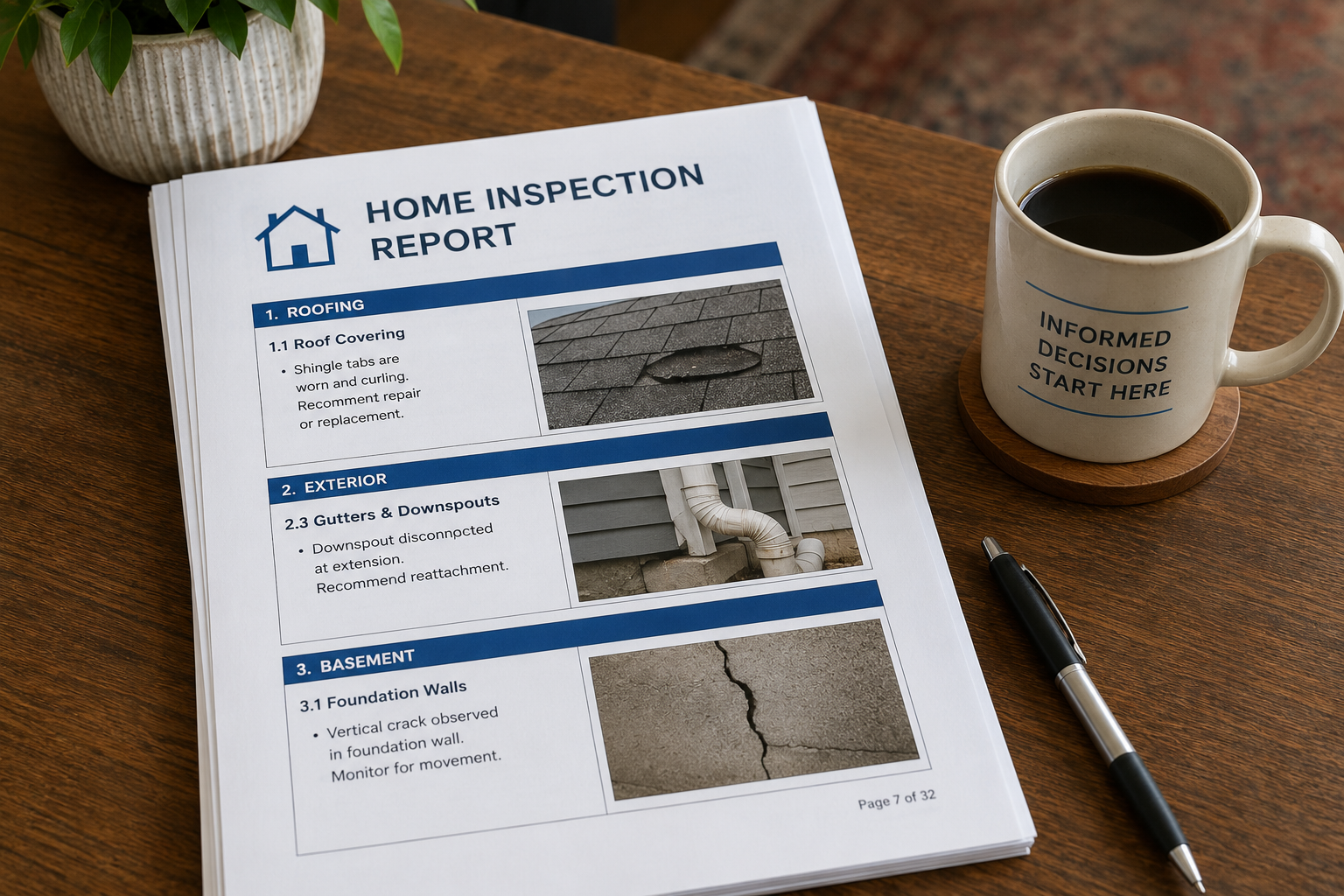
Once the inspection is complete, your inspector will provide you with a detailed written report — usually within 24 to 48 hours — that documents every finding with photos and descriptions.
Your real estate agent will help you review the report and determine which findings are significant enough to address and which are normal wear and tear on any home. Not every item in an inspection report is a deal breaker. Every home — even a brand new one — will have an inspection report with some findings. The goal is to understand the condition of the home and make informed decisions.
From there, you have several options. You can ask the seller to make repairs before closing. You can request a price reduction or a credit at closing to account for the cost of repairs. You can walk away from the deal entirely if the findings are serious enough and your contract includes an inspection contingency. Or you can proceed as is with a full understanding of what you are buying.
The Bottom Line on Home Inspections in Monmouth County
Home inspections in Monmouth County are one of the most important tools available to buyers — but only if you understand what they cover and what they do not.
A standard inspection gives you a thorough professional assessment of the visible and accessible components of the home. It does not cover everything. Radon, mold, sewer lines, underground oil tanks, pools, chimneys, and pests all require separate inspections — and in Monmouth County, several of those are worth adding to your list depending on the age and location of the property.
Go to the inspection. Ask questions. Read the report carefully. And work with a real estate agent who will help you understand the findings and advocate for you every step of the way.
Because buying a home in Monmouth County should feel exciting — and a great home inspection is what gives you the confidence to move forward knowing exactly what you are getting into.
Ready to talk through the home buying process in Monmouth County? Reach out anytime. No question is too small, and no detail is too minor. That is what I am here for. 🏡
📞 732-213-0325 📧 [email protected] 🌐 corisellsnj.com 📘 facebook.com/CoriSellsNJ 📸 @corisellsnj on Instagram
Let’s Get You Home — I’ll Bring the Coffee ☕🏡
